Most business automations can follow directions. Few can hold a conversation.
Early on, chatbots and message workflows handled the simple stuff: confirming appointments, sending updates, or answering FAQs. But when customers asked something nuanced, everything fell apart. The system didn’t understand intent. It just followed basic rules.
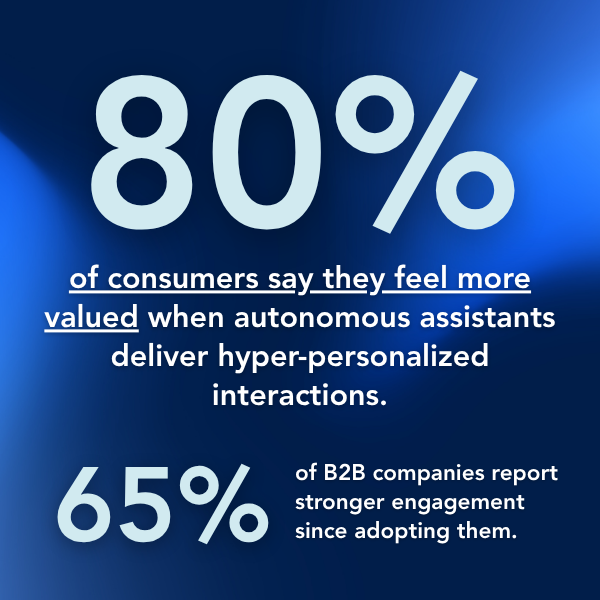
Now that’s changing. Modern conversational AI adds a layer of reasoning and personalization that makes automation feel human again. In fact, 80% of consumers say they feel more valued when autonomous assistants deliver hyper-personalized interactions, and 65% of B2B companies report stronger engagement since adopting them.
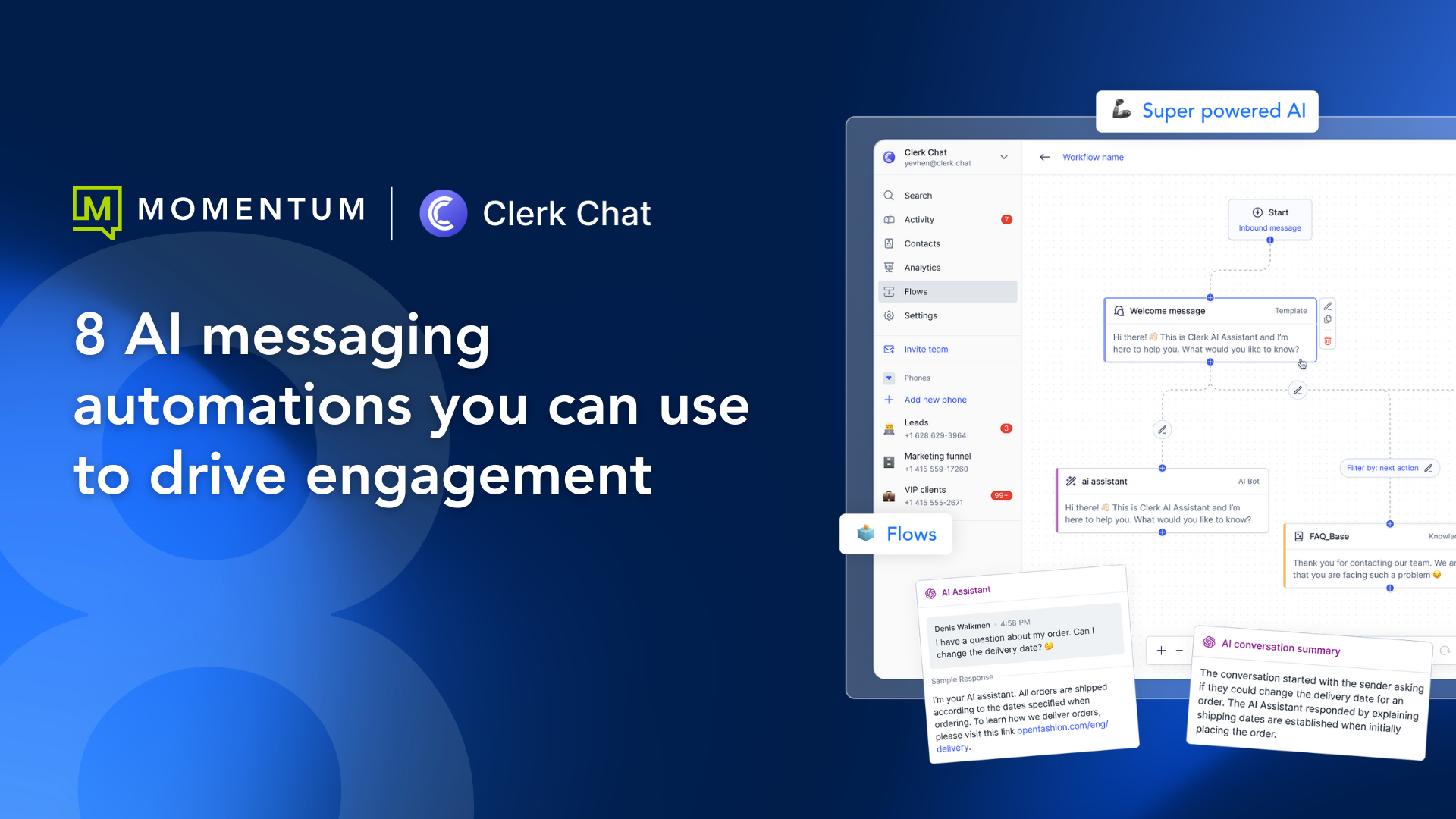
That’s the opportunity behind Momentum Messaging powered by Clerk Chat, bringing conversational, context-aware AI directly into Microsoft Teams and Cisco Webex. These automations don’t just complete a task. They carry the conversation forward, adapting as context changes and escalating only when it matters.
The end result: experiences your customers actually want to use, because they’re fast, relevant, and designed to solve real problems, not just trigger actions.
Here are 8 AI-powered messaging automations, organized by industry, that you can launch right now (and how to get started in under a week).
Why this matters more than ever before
Automation isn’t new, but the expectations around it have changed completely.
Customers no longer see chat or text as secondary channels. They expect instant, intelligent help that feels as natural as messaging a person. Businesses, meanwhile, want to reduce manual handling without sacrificing experience or empathy.
That’s the balance AI now makes possible. The combination of reasoning-capable LLMs, multi-agent workflows, and RCS messaging allows automation to go beyond simple triggers to understand, decide, and act in real time.
Want to learn more about how RCS and AI are changing the game? See our detailed breakdown of RCS and AI in Microsoft Teams.
Rescuing a missed call automatically inside Microsoft Teams
Imagine a customer calls your business line, but no one answers. Right now, they may get an automated message or get sent to voicemail. Not a great customer experience.
With Momentum Messaging (powered by Clerk Chat), the system detects the missed call and immediately sends a verified RCS message from your business number:
- “Sorry we missed your call. Can we help you now, or would you like to book a time that works better?”
If the customer chooses Help now, AI parses intent (“I was trying to update my billing info”) and either routes the chat to the right team or completes the task automatically, all within Microsoft Teams.
If they choose to book a time, it opens a branded scheduling card showing available slots from your connected calendar.
No additional apps, voicemails, or waiting. The customer instantly gets the help they need. This is what modern conversational AI and automation looks like.
8 real automations your customers actually want to use
The most valuable automations aren’t the ones that replace people. They’re the ones that make every interaction feel more human. With Momentum Messaging powered by Clerk Chat, you can build AI-driven, reasoning-based automations that engage customers naturally, adapt to context, and scale across every channel, all from Microsoft Teams or Cisco Webex.
Here are several industry-specific automations you can start using immediately.
Retail
Every second of customer attention counts in retail, but most digital interactions still depend on impersonal email blasts or generic SMS updates that customers may ignore. They don’t adapt, remember context, or make shopping easier. Momentum Messaging powered by Clerk Chat brings AI reasoning and personalization into every step of the buyer journey. Customers can ask questions, check inventory, track orders, or reorder favorite products, all inside a single conversation that feels personal, immediate, and on-brand.
Send personalized back-in-stock alerts
When an item returns to inventory, customers get an immediate, branded message with real availability details and purchase options. AI can tailor the recommendation with messages like: “Your size is back in stock. Want to reserve one?” and answer quick questions about color or delivery times. It works because it’s relevant, conversational, and timed perfectly to intent, converting missed sales into repeat customers.
Automate loyalty rewards and post-purchase upsells
After a purchase, customers can instantly see their loyalty points or receive curated recommendations. AI personalizes the timing and tone, offering complementary products or exclusive promotions without feeling spammy. Because everything happens in-thread, redemption and purchase are one tap away, making rewards more visible and engaging.
Automotive
Buying a car or making a major retail purchase should feel seamless, but customers often hit friction at every step.
- Missed follow-ups
- Outdated forms
- Endless phone tag
Dealers and retailers have long used static systems to send updates or reminders, but they break the moment a customer asks a question outside the script. Conversational AI changes that by combining reasoning, verification, and personalization to guide customers through complex sales or service processes in a single conversational thread.
Schedule test drives instantly
When a customer clicks “Book a test drive,” an automated message picks up the conversation. It confirms the model they’re interested in, offers available times, and even handles rescheduling if plans change. The AI understands casual replies like:
- “Can I come by after work?”
- “Actually, make it Saturday.”
Because the automation connects directly to your CRM and calendar, it has context, and everything updates in real time. It’s faster for customers, lighter on staff, and eliminates lost leads.
Keep customers informed during service appointments
When vehicles enter service, customers receive live updates like:
- “Your car is now in diagnostics”
- “We found an issue with the brakes.”
They can approve work, ask for clarification, or request a callback without ever dialing the shop. It’s a transparent, conversational experience that keeps customers confident and service teams efficient.
Healthcare
Timing and clarity make the difference between a smooth patient experience and a missed opportunity in healthcare. Traditional appointment reminders or web forms handle the basics, but they break when patients ask open-ended questions or need flexibility.
Conversational AI adds reasoning and empathy to these interactions. It transforms every message, from intake to follow-up, into a guided, conversational experience that saves staff time while keeping patients informed and engaged.
Confirm and prepare appointments conversationally
Instead of a static text reminder, patients receive a verified message that lets them confirm, reschedule, or ask pre-visit questions in one thread. If someone replies, “I’ve had a cough for a week, should I still come in?” AI interprets the concern and responds appropriately, either reassuring the patient or routing the message to a nurse for review. This flow keeps schedules full, reduces no-shows, and builds trust through natural, responsive communication.
Simplify pre-visit intake
Collecting patient information doesn’t need to involve clunky web forms or clipboards. With conversational AI, the system can gather key intake details through short, conversational prompts, verifying insurance, confirming medications, or noting symptoms. AI parses responses into structured data fields in your EHR, ensuring accuracy without administrative overhead.
Financial Services
Banking, lending, and insurance all depend on trust and timing. Yet most digital experiences still feel impersonal: long forms, generic emails, and slow callbacks, leading to missed opportunities and frustrated customers. Conversational AI allows financial organizations to automate key interactions while keeping them conversational, compliant, and personal.
AI reasoning handles nuanced questions and exceptions that used to derail static workflows, giving customers clarity and confidence at every step.
Guide customers through prequalification
Instead of filling out lengthy online forms, applicants answer a few short questions in a verified message thread. AI understands natural responses like “I’m self-employed but make about 80K a year” and translates them into structured fields for your CRM or loan platform.This shortens the time to prequalify, improves data accuracy, and delivers a far better first impression.
Send payment reminders that adapt to context
Traditional payment notices often feel cold or rigid. Conversational AI sends helpful reminders and engages in two-way conversations. If someone replies, “I’ll be paid Friday,” the AI can offer to reschedule the due date or suggest a partial payment plan. It’s a small but powerful shift, replacing static notices with empathy-driven automation that protects relationships while reducing delinquency.
Why these workflows work better than traditional approaches
The best technology doesn’t just automate tasks. Instead, it makes every interaction easier for both sides. That’s why AI-driven messaging workflows outperform traditional calls, links, and static forms.
The mechanics are simple, but the results are outsized: intent, identity, and action all stay in one place. Customers recognize the sender, trust the message, and respond instantly. Teams see every interaction alongside call history and notes in Microsoft Teams, so context is never lost.
Here’s why these workflows consistently beat the status quo:
- Familiar channels drive trust and action: Verified business numbers and recognizable names make replying the natural next step.
- Clear choices remove friction: Two or three direct options: confirm, reschedule, and request info help customers act fast.
- Every conversation becomes an asset: One record keeps transcripts, timestamps, and actions in a single audit-friendly thread.
- Teams work where they already work: Owners and supervisors handle messages inside Microsoft Teams.
Build fast with templates that just work
You don’t need a copywriter or a blank canvas to start. Momentum Messaging (powered by Clerk Chat) visual builder comes with ready-made templates and short, proven prompts that teams can launch in minutes.
The content formula is simple:
- A one-sentence opener that sets purpose and value.
- Two clear action buttons with verbs like Confirm, Schedule, or Request Info.
- Short follow-ups that collect only what’s needed for the next step.
- A closing line that sets expectations: what happens next and when.
Every element is built for speed, quick to configure, easy to test, and designed to drive response.
Better together inside Microsoft Teams
Adoption succeeds when tools feel familiar. With Momentum Messaging powered by Clerk Chat, staff never have to log into another app to follow up, and customers never have to install one to respond.
Messages, calls, and context all live in the same pane of glass. Supervisors can monitor interactions, coach faster, and step into live threads with full visibility. Frontline teams save time, leaders gain transparency, and every customer touchpoint stays connected from first outreach to final resolution.
That’s what makes Momentum Messaging different. It automates and unifies communications.
Go from idea to live workflow in a week
This is not a heavy project. With a missed call trigger, a simple template, and a few mapped actions, you can launch quickly and iterate based on real data.
Here’s a rollout plan you can execute this quarter:
- Pick one high-value trigger, such as missed call rescue or appointment rescue.
- Write the success criteria, such as appointments saved from no-shows.
- Configure the follow-up template with two actions mapped to your systems.
- Personalize known numbers from CRM and use a two-step capture for unknowns.
- Launch a pilot with one team, review the scorecard weekly, and refine as needed.