When a school emergency happens, every second between the threat and the law enforcement response is a second too long.
Alyssa’s Law closes that gap. Named after Alyssa Alhadeff, one of seventeen victims in the 2018 shooting at Marjory Stoneman Douglas High School in Parkland, Florida. The law requires public schools to install silent panic alarms linked directly to law enforcement.
The goal is simple: give every staff member a fast, quiet way to call for help without having to pick up a phone or dial 911.
The specifics vary by state, but the core requirements are consistent. Systems must support staff-initiated activation, connect directly to a public safety answering point (PSAP), transmit room-level location data to responders, and keep alerts discreet to avoid escalating a crisis already in progress. Eleven states have enacted the law, more than a dozen others have bills in progress, and federal legislation is under consideration.
If your district hasn’t started planning for compliance, now is the time. Here’s what you need to know.
Key takeaways
- Eleven states and counting: Alyssa’s Law requires silent panic alarms in public schools linked directly to law enforcement. More than a dozen additional states have bills in progress.
- A panic button alone isn’t compliance: Districts need an integrated system built on a reliable network, with activation methods, PSAP connectivity, location data, and security infrastructure working together.
- Funding exists, but windows shift: Federal SVPP grants and state programs have directed hundreds of millions toward school safety. Start planning now so you’re ready when the next cycle opens.
Where Alyssa's Law has been enacted
The law started in New Jersey in 2019. Six years later, eleven states have passed their own versions, including:
| State | Year enacted | Key requirement |
|---|---|---|
| New Jersey | 2019 | Silent panic alarm linked to local law enforcement in every public school |
| Florida | 2020 | Mobile panic alert system ("Alyssa's Alert") integrated with local PSAP |
| New York | 2022 | Mandatory consideration of panic alarms in school safety plans |
| Texas | 2023 | Silent panic alert technology in every classroom by the 2025-2026 school year |
| Tennessee | 2023 | Evaluation of mobile panic alert systems within school safety frameworks |
| Utah | 2024 | Wearable panic buttons, video surveillance, and ballistic glass in all public, private, and charter schools |
| Oklahoma | 2024 | Mobile panic alert systems with floor plans and caller location data |
| Louisiana | 2024 | Panic emergency notification systems linked to law enforcement |
| Georgia | 2025 | Panic buttons, digital floor-plan mapping, and anonymous reporting by July 1, 2026 |
| Washington | 2025 | Collaborative planning for panic alarm installation with $6M in state funding |
| Oregon | 2025 | Wireless or wearable systems integrated with local PSAP by July 1, 2026 |
The pipeline is growing. Bills are pending or under consideration in Alabama, Arizona, Connecticut, Illinois, Kentucky, Maine, Michigan, Mississippi, Ohio, Pennsylvania, and others.
At the federal level, the ALYSSA Act and the Safer Schools Act are both in committee. The trajectory suggests a national baseline could emerge within the next few years, particularly as federal grant programs increasingly tie funding to emergency alerting standards.
What a compliant system looks like
A panic button on its own doesn’t meet the bar. Compliance means building an integrated system where one activation triggers a coordinated response across the entire campus.
That starts with multiple ways to trigger an alert, including fixed buttons in offices and cafeterias, wearable badges that follow staff to hallways and playgrounds, mobile apps with geo-tagged reporting, desktop hotkeys that work even when a screen is locked, or VoIP desk phones with soft-key triggers that send both text and audio notifications.
When the button is pressed, the system needs to do several things at once:
- Alert law enforcement directly with room-level location data
- Swivel security cameras to the source
- Trigger automated door lockdowns
- Broadcast notifications through PA speakers and visual strobes
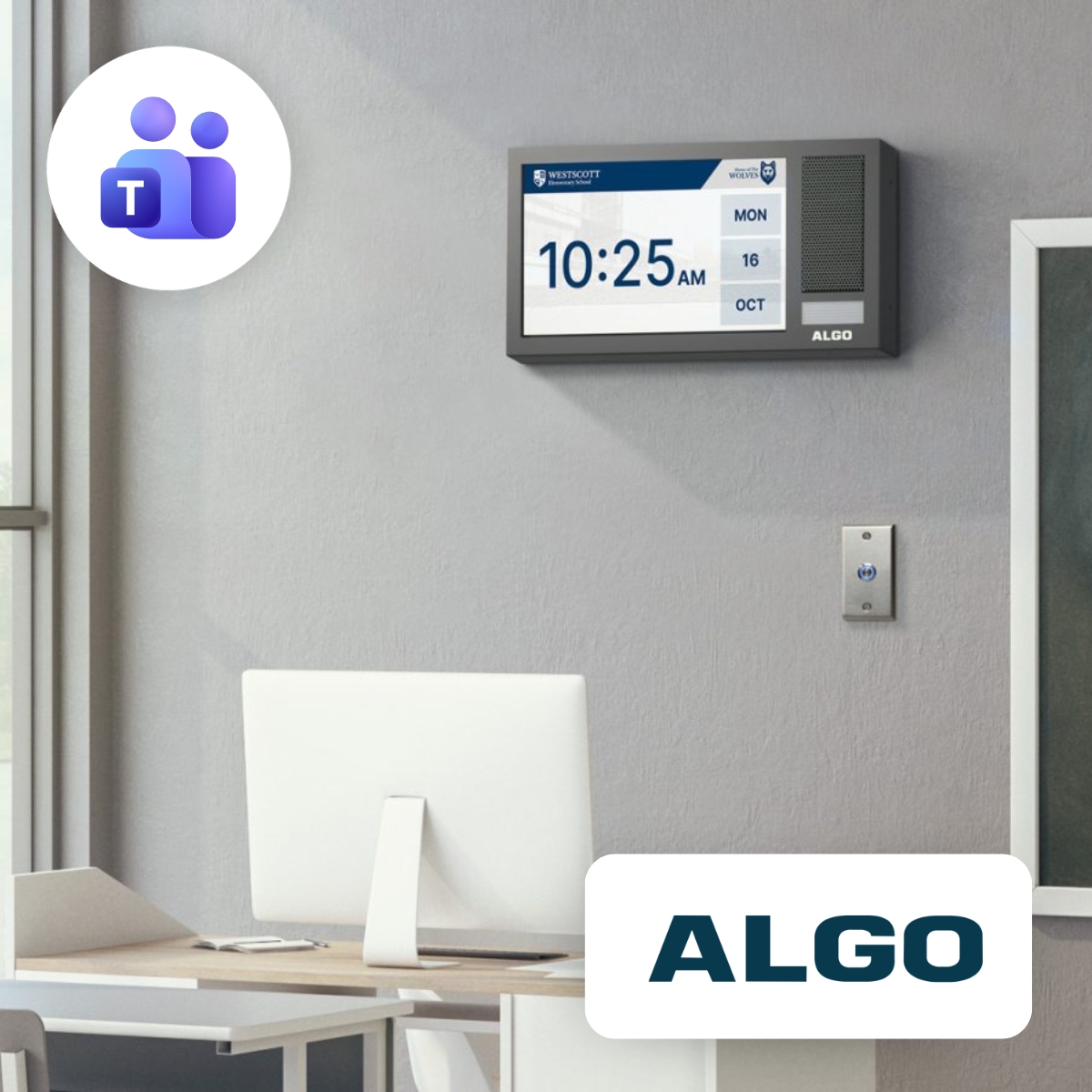
For districts already running Microsoft Teams, this is where Algo IP endpoints become a natural fit. Algo speakers, visual alerters, and call buttons register natively through the Teams SIP Gateway, turning Teams into a campus-wide emergency notification platform. Districts with legacy analog PA systems can bridge them using Algo paging adapters without replacing existing equipment. Momentum manages the full lifecycle from solution design and device selection through deployment and ongoing support.
Why your network is the foundation
None of this works if the network carrying the alert goes down during a crisis. That’s the part most conversations about Alyssa’s Law skip entirely.
Managed SD-WAN gives districts intelligent path selection and traffic prioritization. An emergency alert gets priority over routine administrative data. If the primary fiber line is cut, LTE or 5G failover keeps the system operational.
As safety systems move to the cloud and mobile devices, the attack surface expands. SASE converges networking and security into a single framework, protecting the integrity of emergency alerts and student data across every user and location.
Then there’s the legacy problem. Many districts still rely on analog POTS lines for elevator phones and older alarm systems. CloudLine lets districts keep those mission-critical devices running while migrating everything else to a modern infrastructure.
The panic button gets the attention. The network underneath it is what makes it reliable.
A step-by-step path to Alyssa’s Law compliance
Getting compliant isn’t a single purchase, but rather a sequence of decisions that build on each other. Compliance usually starts with following these steps:
- Know your mandate: Audit your state’s specific requirements. The details matter. Some states require a device in every classroom. Others require wearables. Others require mobile apps integrated with 911 dispatch. Those nuances dictate the technology you choose.
- Assess your campus: Walk the buildings. Identify communication gaps in hallways, cafeterias, gymnasiums, outdoor areas, and anywhere staff can’t currently reach help fast.
- Harden your network: Make sure your infrastructure can guarantee uptime during an emergency. That may mean managed SD-WAN for redundancy, SASE for secure cloud-based access, or configuring the Teams SIP Gateway for IP-based endpoints.
- Explore funding options: Federal and state grant programs have directed significant funding toward school safety compliance. The COPS Office School Violence Prevention Program (SVPP) has historically provided up to $500K per award at 75% cost coverage, with $73M authorized annually through FY2026. At the state level, programs range from Florida’s $6.4M in recurring funds to Texas’s $400M in school safety allocations to Oregon’s per-school reimbursement grants. Availability shifts year to year. Check with your state education agency and monitor cops.usdoj.gov/svpp for updated federal application windows.
- Deploy and integrate: Install hardware campus-wide. Configure silent notifications to law enforcement. Test the direct link to your local police department or PSAP. Integrate with video, access control, and notification systems.
- Train and maintain: Train all staff annually on alarm use, emergency protocols, and their specific roles during a crisis. Test systems regularly. Document everything for state compliance reporting.
The mandate is coming, whether your district is ready or not
Alyssa’s Law started in one state in 2019. Six years later, eleven states have enacted it, more than a dozen have bills in progress, and federal legislation is on the table. The direction is clear whether your state has passed the law yet or not.
Districts that start now with a resilient network, an integrated alerting platform, and a partner who can manage the full lifecycle won’t be scrambling when the deadline hits.
Looking to become compliant with Alyssa’s Law? Talk to an expert to see how Momentum can help you get there.
FAQs
Does Alyssa’s Law apply to private and charter schools?
It depends on the state. Utah includes private and charter schools. Georgia’s law covers both public and private. Florida requires compliance from charter schools. Most other states apply only to public schools, but that’s changing as newer bills expand scope.
What if my state hasn’t passed Alyssa’s Law yet?
You can still prepare. Conduct a facility risk assessment, evaluate compliant systems, and apply for federal grants like SVPP that don’t require a state mandate to be eligible. Districts that build the infrastructure now avoid a rushed deployment later.
Can we use our existing phone system for panic alerting?
In many cases, yes. VoIP desk phones, including those managed through Microsoft Teams, can act as activation points through soft-key triggers. Districts with legacy analog PA systems can bridge them to an IP-based platform using paging adapters without replacing existing equipment.
How long does a typical deployment take?
It varies by district size and infrastructure readiness. A small district with a modern network might deploy in weeks. A larger district that needs network upgrades, grant procurement, and multi-campus coordination could take six months or more. Starting the planning process early is the biggest factor.
Do panic alarm systems require ongoing maintenance?
Yes. Most states require regular system testing, lockdown drills, and compliance documentation. Staff training should be conducted annually and included in onboarding for new hires. The system itself needs firmware updates, connectivity monitoring, and periodic validation of the direct link to local law enforcement or PSAP.