One hardware family, three deep-fit verticals, and a native Microsoft Teams integration that keeps overhead announcements running where workflows live.
Key Takeaways
- One hardware family, three deep-fit verticals: Algo IP speakers, displays, intercoms, and paging adapters serve K-12 schools, hospitals, and manufacturing plants with the same core endpoints adapted to each industry’s workflows.
- Native Microsoft Teams integration: Algo endpoints register directly through the Teams SIP gateway with no SBC required. Dial paging from the Teams contact list, broadcast across zones, and reach displays and SIP desk phones at the same time over multicast.
- Workflow-first, not feature-first: Alyssa’s Law panic buttons, color-coded hospital codes, OSHA fall alerts, ambient-noise-aware plant paging, and bell schedules all run on the same relay inputs, API, and multicast core. The hardware adapts to the workflow.
Overhead paging is one of the last pieces of legacy infrastructure most buildings still depend on. The wiring is old, the controller sits in a closet next to the boiler, and the person who knew how to keep it running has retired. It is also one of the few systems that has to work the moment something goes wrong.
Algo builds IP speakers, displays, intercoms, and paging adapters that retire the closet hardware and register directly into Microsoft Teams. The same core product family adapts to the workflows of three industries where IP paging has moved from optional to operational: K-12 schools, hospitals, and manufacturing plants.
As of April 2026, 13 states have enacted Alyssa’s Law and at least 16 more have introduced versions of it. That single trend is pulling thousands of school districts off legacy paging hardware and onto IP endpoints that can do panic alerts, lockdown displays, and bell schedules from one platform. Healthcare and manufacturing are moving for parallel reasons: ADA compliance, equipment end-of-life, and Microsoft Teams adoption.
See how Algo IP endpoints show up in K-12 schools, healthcare, and manufacturing, what workflows they run, and where Momentum fits in.
What is Algo and how does it fit with Microsoft Teams?
Algo manufactures IP endpoints for paging, alerting, and secure door entry. The portfolio includes ceiling, wall, and horn speakers, IP intercoms, paging adapters that bridge legacy analog gear, LCD display speakers, panic buttons, and the ADMP centralized management platform. Algo has been building this hardware for over 50 years, and they approach the market from the unified communications side rather than the legacy paging side. That matters for integration.
Algo endpoints are third-party SIP devices. They register directly into Microsoft Teams through the SIP gateway, so no Session Border Controller is required for standard deployments. Once registered, an Algo device shows up in the Teams global address list. A user types “paging” into the Teams dialer, hits dial, and is instantly talking to the overhead system. The same endpoint can be a multicast sender, broadcasting to dozens of receivers across a building. It can also be a multicast receiver listening for traffic from another device.
The 8301 paging adapter is the workhorse. It registers to Teams as a SIP endpoint, provides a balanced line output to existing legacy paging amplifiers, and sends multicast simultaneously to new Algo speakers, displays, and Yealink or Poly desk phones. One device retires the old paging head end and bridges to whatever new IP endpoints get added.
Algo also integrates with mass notification platforms like InformaCast, 911 Inform, and Raptor, and connects through APIs and relay inputs to panic buttons, Motorola radios, wearable fall-detection devices, and a long list of third-party safety systems. That flexibility is why the same product family works across radically different industries.
K-12 schools: Alyssa's Law, lockdowns, and bell schedules
K-12 is the largest vertical for Algo and the one driving the most regulatory pressure. Alyssa’s Law requires K-12 public schools to install silent panic alarms that connect directly to local law enforcement. The law has now passed in thirteen states, including New Jersey, Florida, New York, Texas, Tennessee, Utah, Oklahoma, Georgia, Washington, Oregon, Virginia, West Virginia, and Mississippi, with active bills in more than 16 additional states.
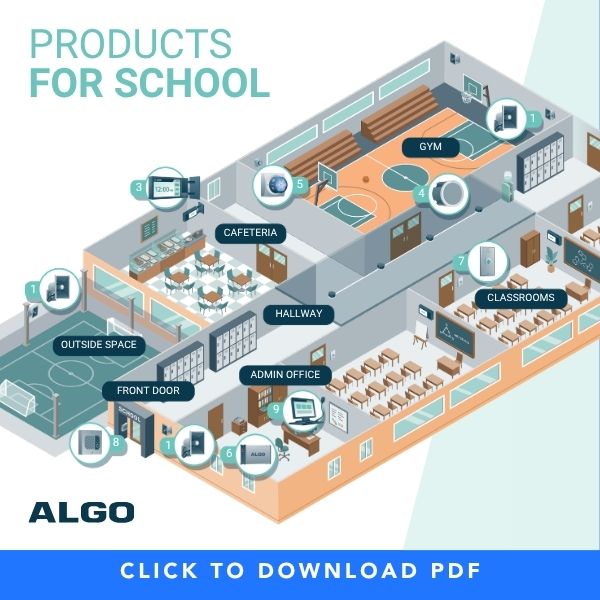
Algo addresses Alyssa’s Law through a panic button wired into the relay input on a ceiling or wall speaker. When pressed, the button triggers a configurable workflow. Common workflows broadcast a pre-recorded lockdown message across overhead speakers, push a customized “Lockdown” or “Active threat” screen to LCD display speakers in every classroom, fire a strobe in hallways, and notify local PSAP through the school’s existing dispatch path. Districts that already have Algo speakers can comply by adding panic buttons to the existing infrastructure rather than ripping and replacing.
The visual notification side matters as much as audio. Algo display speakers are 15.6-inch LCDs with single- and dual-sided variants. Each one is configurable with customized screens for lockdown, fire drill, tornado drill, “code blue,” scrolling text, or whatever the district needs. The display has an IP clock built in, so one device gives a classroom a speaker, a visual alerter, a clock, and a strobe.
Bell schedules, daily announcements, and emergency drills all run from the same 8301 paging adapter that bridges legacy paging amplifiers and broadcasts to new IP endpoints. A district can run a Tuesday morning bell schedule, a fire drill at 10:15, and a real lockdown at 1:42 from the same platform without touching the hardware.
The same workflow logic extends beyond the building. In snow-belt districts where road monitors drive school routes at 2 or 3 a.m. to check ice conditions, the legacy process is a chain of phone calls at the side of the road, hoping the right person answers. With Algo + Teams + Momentum Messaging, the driver fires one trigger from a phone. That trigger pages the staff on-site, schedules a Teams meeting for the business continuity team, and pushes an SMS blast to every parent and faculty member in the district. The driver is back on the road in under a minute.
A key advantage in K-12 is local redundancy. The 8450 IP console combined with Algo speakers can broadcast a page or alert over the LAN even if the internet or phone system is down. As long as power and the network are up, staff have a source of truth to make the page, start the alert, and keep people safe.
Algo products that fit K-12 schools
- 8301 IP Paging Adapter & Scheduler: Bridges legacy classroom and hallway paging amplifiers to the IP network, runs the bell scheduler, and feeds background music.
- IP ceiling and wall speakers (8188, 8198 PoE+, 8189, 8199 PoE+): Cover classrooms, hallways, gyms, cafeterias, and offices. Relay inputs accept panic button wiring for Alyssa’s Law workflows.
- IP Display Speakers (8410 single-sided, 8420 dual-sided):6-inch displays with customized screens for lockdown, fire drill, tornado drill, and scrolling messages. Built-in IP clock and strobe.
- Weather-hardened horn speakers (8197 PoE+): Outdoor coverage for playgrounds, athletic fields, parking lots, and bus loading zones.
- 1203 Call Switch: Wired into the relay input on any Algo speaker, configurable to fire the lockdown workflow when pressed. Algo’s panic button product positioned specifically for K-12 safety.
- 8450 IP Console: Staff-side announcement station for the front office or principal’s office, with LAN-based paging that runs even if the internet or phone system is down.
- Algo Device Management Platform (ADMP): Pushes firmware, monitors device health across every building, and alerts IT before an outage hides a speaker.
Related Content: What is Alyssa’s Law (and what does it mean for your school district)?
Healthcare and hospitals: Code blue, ADA compliance, and mobile staff
Healthcare trailed other verticals on the move to IP paging, and now it is catching up fast. Hospitals run on color-coded scenarios, code blue, code red, code silver, and dozens of facility-specific codes. Each one is supposed to reach a specific set of providers in seconds. Legacy overhead systems broadcast everywhere and depend on staff to recognize the announcement and respond.
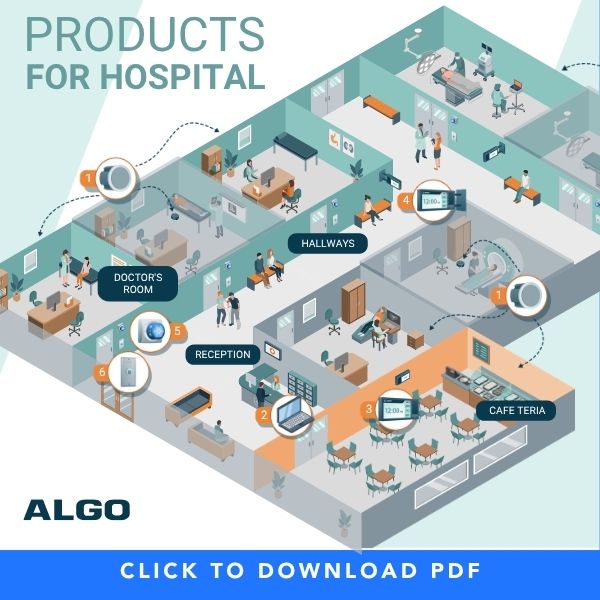
Algo IP endpoints route those codes more precisely. A code blue triggers an overhead announcement on speakers in the affected unit, pushes a “Code Blue, Room 412” screen to LCD displays at the nurses’ station and the elevator lobby, and fires a high-intensity strobe in hallways for ADA compliance. The same endpoint can wake up a mobile staff member’s Teams client with a one-click talk path back to the unit. Color-coded strobes give the team a visual cue when audio is hard to hear over equipment noise or hard to interpret with hearing impairment.
ADA compliance is non-negotiable in healthcare environments. Audio-only paging fails patients and staff with hearing impairment and fails any environment where the audio is masked by equipment. Display speakers paired with strobes meet visual notification requirements without bolting on a separate system. Algo’s wideband HD audio also raises intelligibility in noisy clinical environments where legacy paging used to garble.
ADMP, Algo’s device management platform, matters in healthcare more than almost anywhere else. No hospital wants to find out at the moment of a code blue that a wing’s speakers are offline. ADMP gives IT a constant heartbeat on every endpoint, pushes firmware updates remotely, and alerts on any device that stops responding. Momentum, as an authorized Algo partner, manages this layer end to end.
Algo products that fit healthcare and hospitals
- IP ceiling and wall speakers (8188, 8198 PoE+, 8189, 8199 PoE+): Overhead paging for patient floors, surgical suites, waiting rooms, and clinical hallways. Wideband HD audio raises intelligibility over equipment noise.
- IP Display Speakers (8410 single-sided, 8420 dual-sided): Color-coded screens for code blue, code red, code silver, and other facility codes. Built-in clock and strobe meet ADA visual notification requirements in one device.
- IP Visual Alerters (8128, 8138 Color): Visual alerting in surgical, imaging, and other ambient-quiet areas where audio alone is not enough.
- IP Intercoms (8201 PoE, 8203 Vandal-Proof, 8039 Video Mullion): Secure entry for ICUs, NICUs, pharmacies, and after-hours staff entrances. Register directly to Teams.
- 8301 IP Paging Adapter & Scheduler: Bridges legacy hospital paging head-ends to the new IP network during a phased modernization.
- Algo Device Management Platform (ADMP): Constant device heartbeat across every wing and facility, with proactive alerting before a code-blue alert hits an offline speaker.
Manufacturing and warehousing: Ambient noise, OSHA, and zone paging
Manufacturing environments push paging hardware harder than any other industry. Loud machinery, large floor plates, multiple zones, hearing protection, and personal protective equipment that blocks audible alerts all conspire against legacy systems.
Algo IP speakers handle two of these problems out of the box. The first is ambient noise compensation. Every Algo endpoint has a microphone built in, and when ambient noise monitoring is enabled, the speaker self-amplifies in response to environmental noise. A press line spins up and the paging volume rises automatically. The line goes quiet and the volume drops back. Workers get a consistent, comfortable listening experience instead of being blasted at full volume regardless of conditions.
The second is API flexibility for unusual workflows. Chemical manufacturers can build fall-detection alert systems for OSHA compliance using Algo’s API. Employees wear impact-detection devices. When a fall is detected, the device triggers an Algo overhead announcement on the floor, pushes a notification through Algo’s API to a supervisor’s Teams client, and fires a strobe in the area. The same flexibility lets a plant reach a worker in a biohazard suit when a critical message needs to get through. Multicast pushes the announcement to the overhead speakers and to nearby Poly desk phones, so the worker can hear it through hearing protection and respond.
Zone paging across multiple buildings is a third manufacturing pattern. Algo endpoints support up to 50 zones natively. A plant manager can page the loading dock without paging the production line, page warehouse aisle 7 without disturbing the office wing, or broadcast a plant-wide announcement that hits every zone at once.
POE+ satellite speakers simplify deployment in large facilities. Up to four speakers daisy-chain off one POE+ drop. They share power, share configuration, and act as one IP endpoint. Network teams use half the cable runs and half the network drops. The trade-off is that all four speakers are in the same zone, so the model fits warehouse aisles, common areas, and hallways rather than spaces that need individual addressing.
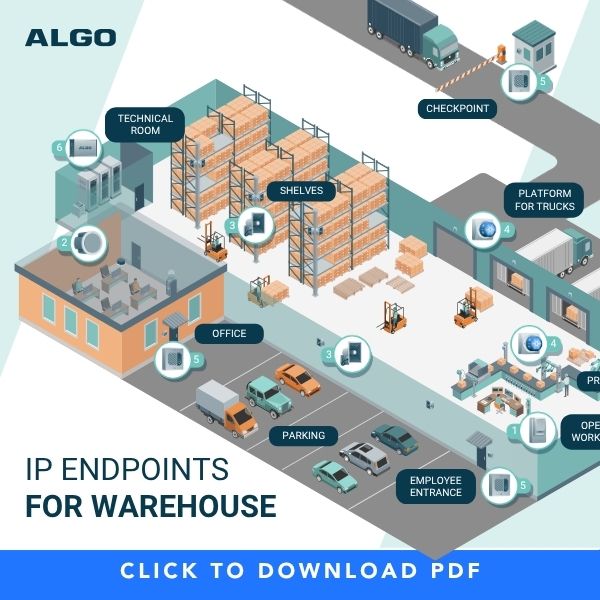
Algo products that fit manufacturing and warehousing
- Weather-hardened horn speakers (8197 PoE+): Loading docks, outdoor yards, parking areas, and high-humidity zones. Self-amplifying for loud equipment environments.
- PoE+ satellite speakers (1196, 1197 weather-hardened, 1198 ceiling, 1199 surface mount): Daisy-chained groups of up to four speakers off one PoE+ drop, ideal for warehouse aisles, long hallways, and common production areas.
- IP ceiling and wall speakers (8188, 8198 PoE+, 8189, 8199 PoE+): Office wings, breakrooms, control rooms, and shipping floors. Ambient noise compensation adjusts volume automatically.
- 1203 Call Switch and relay inputs: Wired throughout the plant for area-specific alerts, integrated through API with wearable fall-detection devices for OSHA workflows.
- 8301 IP Paging Adapter & Scheduler: Bridges legacy plant-wide paging amplifiers during modernization and feeds shift-change chimes.
- 8373 IP Zone Paging Adapter: Used in the largest facilities for connecting multiple amplifier zones across a campus.
- Algo Device Management Platform (ADMP): Multi-site device health monitoring and firmware control across plants in different regions.
What ties all three industries together
Three different industries, three different workflows, one hardware family. The common thread is that Algo is workflow-driven. Whether the trigger is a panic button, a console microphone, a bell-schedule timer, an API call from a wearable fall-detection device, or a hot button in a Teams app, the endpoint runs the same job: get the right message to the right zone in the right format with the right audience.
The features matter, but they exist because real environments demanded them. Wideband HD audio came from environments where intelligibility failed with narrowband. Ambient noise compensation came from manufacturing. Display speakers came from ADA requirements in schools and hospitals. POE+ satellite speakers came from network teams asking for fewer drops and less cabling in large facilities. Direct Teams SIP gateway registration came from years of integration work where SBC-routed direct routing was the only path.
Momentum is an authorized Algo partner with full ADMP access. That means the management layer, firmware updates, monitoring, configuration changes, zero-touch provisioning, sits with Momentum, not with the IT team running the environment. From initial design through ongoing support, one team handles the device layer.
Deploy Algo with the team that owns the rest of your communications stack
Every use case in this article solves a specific problem: a missed lockdown alert, a delayed code blue, a worker down on a manufacturing floor. The common thread is that Algo IP endpoints work because they meet the workflow where it lives, inside Microsoft Teams, inside the security platform, inside the mass notification system, inside the network.
Momentum brings the rest of the stack together. One provider to handle Teams Phone, SIP, SD-WAN, and the Algo endpoints. One bill that covers connectivity, voice, and the device management layer. One team to own the relationship from design through day-two support. No finger-pointing between the network vendor, the UC provider, and the paging integrator when something goes wrong.
Talk to an Algo expert at Momentum to see how IP paging fits your environment.
Call us: 877.251.5554
Book a call with the Momentum team: gomomentum.com/contact
Frequently asked questions
Does Algo work with Microsoft Teams?
Yes. Algo IP endpoints are SIP devices that register directly into Microsoft Teams through the SIP gateway. No Session Border Controller is required for standard deployments. Once registered, the device appears in the Teams global address list and can be dialed from the Teams contact list the same way as any other user or resource.
Does Algo support Alyssa’s Law compliance?
Yes. Algo addresses Alyssa’s Law through panic buttons wired into the relay inputs on its IP speakers, displays, horns, and strobes. The button triggers a configurable workflow that can include silent alerts to law enforcement, pre-recorded overhead messages, lockdown screens on display speakers, and integration with PSAP through the school’s existing dispatch path. As of April 2026, Alyssa’s Law has passed in 13 states, and Algo deployments in those states already meet the silent panic alert requirement.
Can Algo integrate with mass notification platforms?
Yes. Algo integrates with InformaCast, 911 Inform, Raptor, and other mass notification platforms. Some integrations use a license on the Algo endpoint itself, while others run through API or multicast. Momentum can help maintain an existing InformaCast deployment, or replace its SMS notification piece with Momentum Messaging powered by Clerk Chat tied into the Algo workflow when InformaCast is no longer the right fit.
What is the Algo 8301 paging adapter used for?
The 8301 is Algo’s best-selling paging adapter. It registers to a UC environment like Microsoft Teams as a SIP endpoint, provides a balanced line output to legacy paging amplifiers, and sends multicast simultaneously to new Algo speakers, displays, and compatible SIP desk phones from Yealink and Poly. It also has a port for background music and a built-in bell scheduler. One 8301 typically replaces the legacy paging head end and bridges to any new hardware added to the network.
What is ADMP and who manages it?
ADMP is the Algo Device Management Platform, Algo’s centralized management tool for IP endpoints. It pushes zero-touch provisioning, firmware updates, configuration changes, and monitors every device for health and connectivity. As an authorized Algo partner with unlimited ADMP access, Momentum manages this layer end to end, including proactive monitoring, alerts on offline devices, and remote configuration changes.
How many zones can Algo support?
Algo IP endpoints support up to 50 zones natively. That covers most school campuses, hospitals, manufacturing plants, and warehouses without needing additional hardware. Larger deployments use the 8373 paging adapter for connecting multiple amplifiers across the largest facilities.
Does Algo work for industries outside K-12, healthcare, and manufacturing?
Yes. The three industries covered above are the deepest fits, but Algo also serves banking, retail, hospitality, airports, higher education, government, and faith-based organizations. The hardware is workflow-driven rather than vertical-specific, so the same endpoints adapt to most environments. Talk to a Momentum specialist about your specific use case.